By J. Yekeh F. Kwaytah / 28/Jan/2026 /
Boakai Puts Roads at Center of National Growth
President Joseph Nyuma Boakai, Sr. has declared road development a central pillar of Liberia’s economic revival, telling lawmakers and the nation that improved infrastructure is critical to prosperity, national unity, and inclusive growth.
Delivering his State of the Nation Address on Monday, January 26, 2026, President Boakai said his administration has placed road construction and rehabilitation at the heart of governance, arguing that reliable transport networks are transforming livelihoods by connecting county capitals, farming communities, and rural villages year-round.
“We focused on restoring key corridors and expanding secondary roads ensuring year-round access,” the President said, stressing that improved connectivity is already reducing travel time, cutting transportation costs, and expanding access to markets and essential services.
Liberia’s road sector has long been a development bottleneck, with only a fraction of the country’s estimated 11,422 kilometers of roads paved and many rural regions isolated during the rainy season.
Addressing this gap is a core objective of the National Development Plan 2025–2029, which prioritizes infrastructure as a catalyst for economic integration.
Under the Boakai administration, paved roads have increased from under 12 percent to at least 20 percent of the national network.
Officials say this jump is reshaping mobility across key regions, especially along corridors that were once impassable for months at a time.
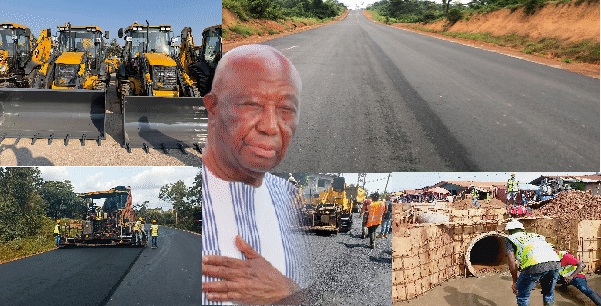
Major road projects are advancing steadily. The Ganta–Saclepea road is now 56 percent complete, Saclepea–Tappita has reached 92 percent, and the Sanniquellie–Logatuo corridor stands at 86 percent completion.
In the southeast, the Kelipo–Fish Town route is fully paved, significantly improving access across the region.
The President also announced progress on strategic future investments, including the Buchanan–Greenville highway, a vital coastal route expected to boost trade, tourism, and regional commerce.
The project is backed by international partners such as the African Development Bank and the World Bank.
To sustain gains and strengthen maintenance capacity, President Boakai confirmed that 285 heavy-duty road machines popularly known as “yellow machines” are en route to Liberia.
The equipment will be deployed across county hubs, enabling faster maintenance, emergency response, and routine road upkeep nationwide.
While acknowledging delays on some projects, including the RIA Road Corridor due to audits and revised scopes of work, the President assured citizens that reviews are nearing completion and full construction will resume in 2026.
Despite the pause, paved sections along the corridor have already expanded from 20 to 25 kilometers.
The administration is also leveraging public-private partnerships to accelerate delivery. Through the Pavifort Concession Agreement, construction is set to begin on priority corridors such as Saint Paul Bridge–Bo Waterside, Medina–Robertsport, and Mendikorma–Voinjama, with groundbreaking scheduled next month.
Urban infrastructure is receiving renewed attention as well. Alleyway paving, drainage upgrades, and street lighting projects are underway in Sinkor, Vai Town, Caldwell, and other communities, while new overpasses along Tubman Boulevard are under construction to ease congestion and improve traffic flow by 2027.
President Boakai reported that since taking office, 411 kilometers of rural roads and 122 kilometers of urban roads have been paved.
By 2029, the government aims to surpass 485 kilometers of paved roads nationwide.
As Liberia presses ahead with its infrastructure drive, the President said the vision is clear: roads are no longer just pathways, but engines of opportunity linking communities, stimulating economic activity, and reinforcing national cohesion.



No Comment Yet!