heritage news / 29/Aug/2025 /
Liberia Secures TICAD 9 Gains
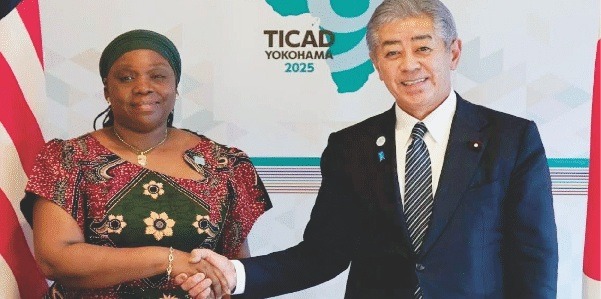
Liberia’s participation in the Ninth Tokyo International Conference on African Development (TICAD 9) held in Yokohama, Japan, has produced an unprecedented wave of opportunities that experts are already describing as a turning point in the country’s development trajectory.
Under the theme “Co-Creating Solutions for Africa’s Future,” Liberia joined global and continental leaders in charting pathways for sustainable growth.
The outcomes, announced by the Ministry of Foreign Affairs, reflect the Boakai administration’s determination to leverage strategic partnerships for the benefit of the Liberian people.
In line with Japanese Prime Minister Ishiba Shigeru’s renewed commitments to Africa, Liberia secured sweeping benefits across infrastructure, investment, agriculture, health, youth empowerment, and governance.
These gains position the nation as a key beneficiary of Japan’s pivot toward private-sector-led sustainable growth and human capital development.
One of the most celebrated outcomes is the Infrastructure Partnership. Japan and Liberia agreed to conduct feasibility studies for the Monrovia–Roberts International Airport corridor and rehabilitate key farm-to-market roads.
According to the Foreign Ministry, these interventions will unlock regional trade and transform connectivity for rural farmers.
The conference also ushered in progress on port modernization. Liberia has been included in the new Japan-Africa Economic Partnership Study Group, guaranteeing technical support for Freeport of Monrovia upgrades and improved logistics.
Officials say the modernization drive will reduce trade bottlenecks and expand Liberia’s role in regional commerce.
Under industrial cooperation, Liberia will benefit directly from the Japan Africa Co-Creation for Industry Initiative. This program will connect Liberian startups with Japanese companies, focusing on ICT, agribusiness, and clean energy.
Financing access also emerged as a major win. Liberia is now positioned to tap into Japan’s expanded Enhanced Private Sector Assistance for Africa program worth USD 5.5 billion, alongside a USD 1.5 billion impact investment fund.
This will reduce investment risks in Liberia’s agriculture and energy sectors, unlocking new capital flows.
Another critical partnership involves sea defense and environmental protection. With Liberia’s coastline facing severe erosion, Japan pledged to collaborate on advanced coastal protection measures, drawing from its world-class expertise in artificial islands and marine defenses. Waste management solutions are also under discussion.
In agriculture and food security, Liberia will pilot climate-resilient rice varieties in Lofa and Bong Counties, under JICA-supported initiatives. Mechanized farming projects will also be expanded, offering a direct pathway to reduce rice imports.
Furthermore, Liberia will access TICAD’s agricultural technology package, which includes Japanese irrigation systems and post-harvest value chain support.
Experts believe this could dramatically shift the nation’s dependence on imported food and empower smallholder farmers.
Human capital development featured prominently in Liberia’s benefits. At least 500 Liberian youth and professionals will benefit from Japan’s continental plan to skill 300,000 Africans in artificial intelligence, biotechnology, and the green economy.
Scholarship opportunities were also secured. Through the ABE Initiative and Africa Youth Program 2025, Liberian students will study in Japan in fields such as STEM, governance, and public health. These scholarships are expected to produce a new generation of change-makers.
On women’s empowerment, Liberia was invited to join Japan’s Women, Peace and Security framework. This will expand access to leadership training and entrepreneurship support for Liberian women, furthering gender equality.
In health, Liberia stands to benefit from Japan’s African Healthcare Investment Promotion Package. This includes upgrading referral hospitals, medical equipment grants, and personnel training. Combined with Japan’s USD 550 million contributions to GAVI, Liberia’s vaccine supply will be secured in the post-COVID era.
Security and governance cooperation were also highlights. Liberia’s maritime sector will receive capacity building to counter illegal fishing and improve coast guard readiness.
Additionally, the country will engage in the Africa Mine Action Platform and peacebuilding programs focused on governance and youth inclusion.
Perhaps most notably, Liberia submitted a USD 72 million funding proposal to the Government of Japan during the conference.
The proposal covers infrastructure, education, health, and agriculture projects and is currently under review. Observers say approval could further amplify Liberia’s transformation agenda.
To ensure accountability, the Ministry of Foreign Affairs will establish a TICAD 9 Implementation Desk. This desk will track commitments, provide quarterly progress reports, and guarantee that promises made translate into results on the ground.
“This historic engagement has delivered concrete partnerships in infrastructure, agriculture, education, youth empowerment, health, governance, and environmental protection. The Government of Liberia remains committed to translating these gains into sustainable development and improved livelihoods,” the Ministry said in its release.
Liberia returns from TICAD 9, the mood is one of optimism. Analysts argue that if properly implemented, the package of commitments secured in Yokohama could mark the beginning of a new chapter in Liberia’s quest for prosperity and resilience.




No Comment Yet!