heritage news / 05/Dec/2025 /
NOCAL Probes Bassa Seep
The National Oil Company of Liberia (NOCAL) has launched a full technical investigation into a reported hydrocarbon seep in Grand Bassa County, confirming growing national interest in what could be an important geological development.
The suspected seep was reported in Nevren Tan, Beon Town, a community located within the Roberts–Bassa Basin, an area already known in previous studies for its petroleum indicators. The site lies roughly 7.6 miles inland from the Atlantic coastline.
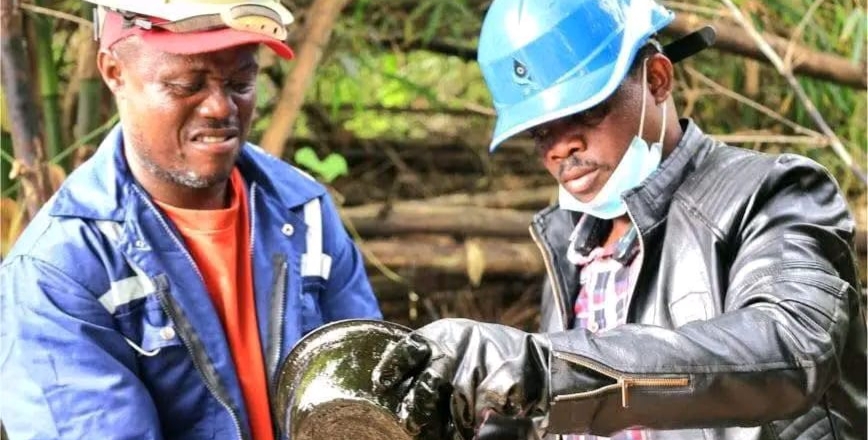
Following the alert, NOCAL immediately dispatched two separate field missions to the area, deploying geoscientists and technicians to conduct reconnaissance and gather baseline information.
The teams carried out surface geology observations, mapping, and site verification to establish the credibility of the report.
The corporation said its early assessments show that the physical characteristics of the seep zone correspond with known structural features of the Roberts–Bassa Basin, a region historically flagged as having potential for hydrocarbon deposits.
Previous surveys lend weight to the current investigation. In 2010, airborne gravity and magnetic studies conducted by Simba Energy then the only holder of an onshore reconnaissance license identified multiple oil seep signatures within the basin.
Those studies suggested that parts of the basin may contain conditions favorable for commercially viable petroleum systems, prompting interest that has resurfaced with the latest report.
During last week’s assessment, technicians from both NOCAL and the Liberia Petroleum Refining Company (LPRC) conducted soil sampling, reviewed archived datasets, and carried out geological mapping to establish whether the seep reflects deeper subsurface activity.
Samples taken from the site have been forwarded for extensive laboratory testing. Analysts will examine API gravity levels to determine the nature of the fluid and whether it can be classified as sweet or sour.
Additional testing will include biomarker profiling and specialized geochemical diagnostics aimed at identifying the source rock, maturity level, and possible migration pathways of the suspected hydrocarbon.
NOCAL stressed that no definitive conclusion can be made until the laboratory results are completed.
Officials noted that the findings must be integrated with field observations and historical geological data before a scientific determination can be issued.
The company acknowledged heightened public interest, describing the matter as one of “national importance” due to the potential implications for Liberia’s energy sector.
But NOCAL also issued a caution, urging government agencies, community leaders, media institutions, and public commentators to avoid sharing unverified information while the investigation is still underway.
According to the corporation, premature claims could mislead the public and interfere with the integrity of the scientific review process, which depends on careful, evidence-based evaluation.
NOCAL reaffirmed that transparency remains central to its operations and pledged to release a comprehensive, factual update as soon as the laboratory and field assessments are concluded.
The company concluded that its geo-scientific teams remain on standby to conduct additional surveys if the initial laboratory results point to more complex subsurface activity.
For now, NOCAL says it is focused on ensuring that its findings are accurate, independently verifiable, and consistent with international petroleum exploration standards.




No Comment Yet!