heritage news / 01/May/2026 /
U.S. Backs Morocco Sahara Investment Push
The United States has reaffirmed its recognition of Morocco’s sovereignty over Western Sahara, reinforcing Rabat’s position while simultaneously signaling strong support for expanded economic investment in the region as part of a broader strategic alignment in North Africa.
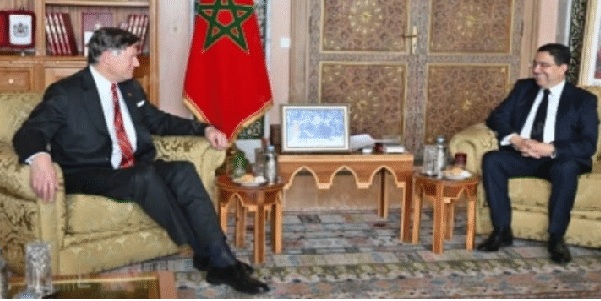
The announcement came during a joint press conference in Rabat, where U.S. Deputy Secretary of State Christopher Landau met with Moroccan Foreign Minister Nasser Bourita following high-level bilateral discussions focused on diplomacy, trade, and regional security cooperation.
Speaking to reporters, Landau emphasized that Washington’s stance remains unchanged, declaring unequivocally that the United States continues to recognize Morocco’s sovereignty over Western Sahara, a policy position that underscores enduring diplomatic continuity despite changes in U.S. administrations.
The Western Sahara conflict, one of Africa’s longest-running territorial disputes, traces its origins to 1975 when Spain withdrew from the territory, creating a power vacuum that led to competing claims over sovereignty and self-determination.
In the aftermath of Spain’s exit, Morocco moved swiftly to annex much of the territory, prompting armed resistance from the Polisario Front, which has since championed the cause of independence for the Sahrawi people.
The conflict quickly assumed a regional dimension, with Algeria backing the Polisario Front politically and militarily, thereby deepening geopolitical rivalries across North Africa and complicating efforts to reach a negotiated settlement.
A ceasefire agreement brokered in 1991 under the auspices of the United Nations halted large-scale hostilities and included provisions for a referendum on self-determination, though that process has remained stalled due to persistent disagreements over voter eligibility and political conditions.
Today, Western Sahara remains effectively divided, with Morocco administering roughly 80 percent of the territory while the Polisario Front controls the remainder, leaving the region in a prolonged state of political uncertainty and diplomatic deadlock.
Washington’s recognition of Moroccan sovereignty was first formalized under former U.S. President Donald Trump in December 2020, as part of a broader geopolitical arrangement tied to the Abraham Accords, which saw Morocco normalize diplomatic relations with Israel.
Despite subsequent leadership changes in Washington, the policy has remained intact, signaling a rare instance of bipartisan continuity in U.S. foreign policy and reinforcing Morocco’s standing on the international stage.
Landau reiterated U.S. backing for Morocco’s autonomy initiative first proposed in 2007, describing it as a serious, credible, and realistic framework capable of delivering a durable political solution to the decades-long conflict.
The autonomy plan envisions granting Western Sahara a degree of self-governance under Moroccan sovereignty, an approach that has steadily gained support among several Western and Arab nations seeking a pragmatic resolution.
Referencing United Nations Security Council Resolution 2797, Landau stressed the urgency of resolving the dispute, warning that the international community cannot allow the stalemate to persist indefinitely without undermining regional stability.
He noted that the lack of progress over nearly five decades continues to hinder economic integration across North Africa, limiting opportunities for trade, investment, and broader development in the region.
Beyond diplomatic support, the United States signaled a strong economic dimension to its engagement, encouraging American companies to explore investment opportunities in Western Sahara, particularly in renewable energy, fisheries, and critical infrastructure.
Morocco has already committed significant financial resources to the development of the territory, including large-scale infrastructure initiatives such as the Dakhla port project and extensive solar energy programs designed to position the region as a strategic economic hub.
Analysts suggest that Washington’s position reflects broader geopolitical considerations, including the need to promote stability in the Sahel, strengthen counterterrorism partnerships, and expand economic engagement across Africa.
While the U.S. reaffirmation provides Morocco with strengthened diplomatic backing and potential economic momentum, the path to a final resolution remains uncertain as the Polisario Front continues to reject the autonomy proposal in favor of full independence, leaving the long-standing dispute unresolved.



No Comment Yet!